FarmIT 3000 Farm Accounts
Keeping accurate accounts is of course a requirement of all businesses. In farming however,
the actual farming often takes precedence and probably rightly so. Accounts record keeping is often an afterthought
or even ignored as a job for a rainy day. Its main aim is to reclaim the VAT and ensure we do not pay any
tax.
But keeping farm accounts properly has a lot more to offer you than that.
When it comes to the mechanics of accounting farming has its idiosyncrasies. The majority of farmers in the UK sell at market or to
a slaughter house.
Markets and Slaughterhouse both provide the Farmer with invoices including deductions for processing.
The Farmer does not generate this invoice himself, however this invoice does need to be recorded in the farm accounts and the deductions (contra charges) processed correctly in order to reclaim VAT.
Accounts for VAT
As the farm's main product, i.e. food tends to be ZERO rated for VAT and most farms purchases have VAT, a farms VAT return is normally a reclamation of that VAT on purchases. This reclaimed VAT if often the critical factor in the overall profitability of the farm and therefore it is fully understandable that it is seen as the most import factor in keeping farm accounts.
Accounts for TAX
After VAT the next main reason for keeping farm accounts is to minimise tax liability, and why not. All businesses need to minimise paying tax as maintaining this money within the business if obviously beneficial. Being able to assess your income quickly will therefore help you in this by easily identifying your taxable income.
Accounts for Accountants
Your accountant will no doubt rather be presented by a list of invoices and bills broken down into categories rather than a box of paper.
This however does not mean that he will neccessarily charge you less. He will no doubt try to minimise your
tax liability and advise you on other issues. He will not be interested in analysing your accounts in detail, but
will simply compile the required information for your tax return.
Accounts for Analysis
Accounting is much more than VAT and tax. It includes tracking creditors and debtors, bank reconciliation and categorising income and expenditure for overall analysis of business performance.
To put it bluntly and in farming terms, do sheep make more money than cattle? Are we spending to much on fencing?
Or why did we make a loss? These are the questions that accounting should answer. This is achieved by breaking down bills and invoices into items and assigning those to ‘accounts’ such as ‘VET and Med’, ‘fencing’, ‘Lamb Sales’, ‘Ewe Sales’ or ‘Cattle Sales’. These account categories can then be analysed at the end of the year or period for profit and loss. You may also wish to assign these categories into enterprises for example ‘Sheep Production’ or ‘Cattle Production’
FarmIT 3000 Accounts in Detail
FarmIT 3000 Gold includes a completely integrated accounts package, tailored
specifically for farmers. The package includes all aspects of a modern
accounting package from creating invoices, entering bills, producing VAT
returns, bank reconciliation, customisable accounts and enterprises. Full reports
are provided for accounts receivable and payable, tracking customers and
suppliers, profit and loss etc. The following paragraphs highlight the main
advantages of FarmIT 3000 Accounting.
Invoices With Contra Charges
Farm IT provides an invoicing system that allows you to enter an invoice generated for you by a market simply by entering the contra charges and deductions as you enter the invoice, this reduces the need to end the invoice then enter the deductions as a bill.

When this invoice is completed the top section is attributed to income (in this
case Highland Cattle income) and the low section to expenditure (Cattle Market
Fees), VAT is automatically calculated and attributed to the VAT return.
Customisable Chart of Accounts
FarmIT 3000 comes with a basic outline set of account categories specific to a farm business. This is intended to help you get started and is fully customisable should it not be relevant. Each account can be assigned to an enterprise.
Account Enterprises
Enterprises allow us to analyse account income and expenditure for an enterprise, for example Cattle or Sheep, Arable or holiday cottage. You may add account categories and assign them to an enterprise. You may then analyse profit and loss for the whole business or by select enterprise.
Splitting accounts between Enterprises
|
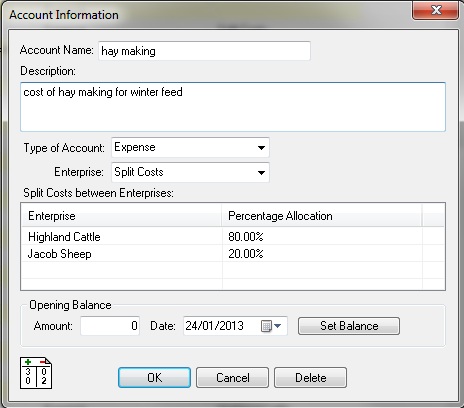
One specific feature of FarmIT 3000 is to allow you to split an account based on a percentage allocation between multiple enterprises. This is particularly useful when dealing with feed costs and vet and med costs. In an ideal world we would take great care to attribute any feed purchased
for sheep to the ‘Sheep Feed’ account and cattle fodder to ‘Cattle Feed’ account. However, in reality this is very hard to do on a farm as some Vet and med will be used on both sheep and cattle, and hay and straw will be used adlib by both. Asking your stockmen to report daily just how many bales he has fed is probably going to be difficult.
The ability to split costs after the allocation to an account is therefore very useful. We may even adjust this allocation later without modifying the invoices or bill entries. This will not affect your accounts for the business or your VAT or
tax but will let you assess the profitability of sheep against cattle more accurately.
|
Flexibility
FarmIT 3000 is designed to flexible and we realise that you do not always get thing right first time and therefore we let you modify and change things
and even delete invoices if they are unpaid and re-enter bills etc. You will find FarmIT easy to use, however it is a full accountancy package with features that go well beyond a simple cash book. Do not be put off by this
and as time goes on you find that these features are useful.
Summary of Features
Create invoices (including contra charges)
Enter bills
Record received payments
Pay bills
Definable accounts for income, expenses, bank etc
Farm enterprises
VAT, VAT return, VAT tracking and reconciliation
Bank account reconciliation
Write and track cheques
Definable payment terms and methods
Reports for profit and loss, accounts receivable, accounts payable etc
Nominal ledger, sales ledger and purchase ledger
Journal and journal entries
Cash flow forecast
Download our accounts book for a more detailed guide to FarmIT 3000 Accounts
FarmIT 3000 Accounts Book - 1.91MG