Weighing Options With Farm IT Mobile
Whether you are weighing sheep, cattle or deer, the FarmIT Mobile software provides three methods for recording the weight of an animal.
1. Manual entry is of course the simplest. i.e you read the EID of the animal (or
enter its tag) then type in the weight. This is obviously time consuming and requires your to press buttons and therefore not that much fun.
But can be acheived with a spring balance scale at a fraction of the price of
electronic ones.
2. An improvement is a button that you click to get the weight from the weigh head. Saves keying in the weight!
But requires a electronic scale.
3. Weigh Scales mode, where we connect to the scales perminently extract the weight without you pressing buttons
at all!
Options 2 and 3 require you to have a Weigh head such as the Tru-Test EW7 with bluetooth communication built in or a Weigh Head with a bluetooth dongle. The weigh head also has to be on the list of FarmIT Mobile scales.
What is Bluetooth?
Back in the early days of computers ('Like up until 10 years ago') connecting two
computers or devices together required WIRES!. This is however not to be seen as
OLD technology as in fact it still has its place, however with the advance of
mobile and hand held devices wires are of course a problem. The wires (cables
and leads) connected into 'ports', the most common type being RS232 serial ports
commonly refered to as 'COM' ports. A computers could have meny 'COM' ports so each
port got a number. COM1 , COM2, COM3, etc. Programs (Old reference now called 'Apps') would use the COM port to actually exchange the data.
Most (but not all) electronic scales provide a serial port interface for
exchanging data with a computer. The Tru-Test EziWeigh 5 for example does NOT.
The Tru-Test EziWeigh 7 DOES.
Bluetooth is the trendy name given to a specific type of wireless communication. Two bluetooth dongles linked together replace a cable. If a device has a built in bluetooth dongle the it can connect to other devices with bluetooth. The process of connection is refered to as pairing and part of the pairing process assigns a COM port. The COM port setting is then used by the APP!
The PSION Workabout Pro has built in bluetooth and can link to a weigh head with
bluetooth such as the EW7. Once paired you can configure the FarmIT Mobile
software to use the weigh head as long as you know the COM port.
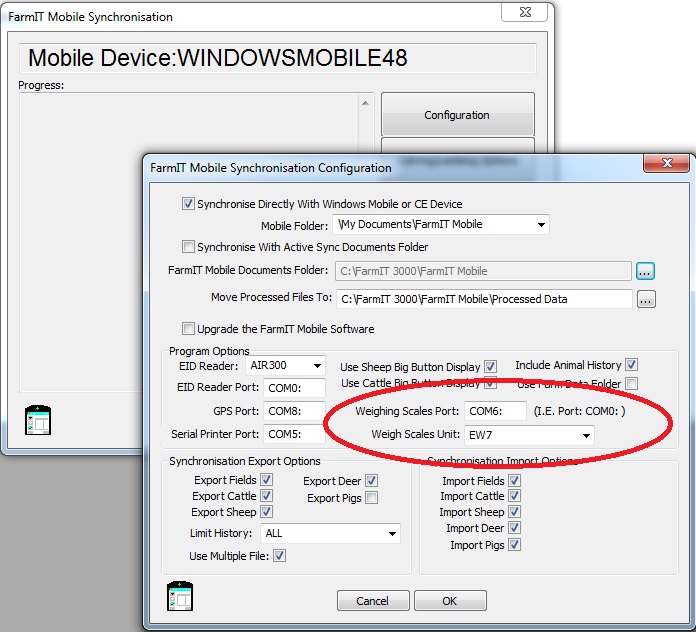
FarmIT Mobile Configuration
The FarmIT Mobile software is configured from within the main FarmIT3000
Software. First connect your psion to the PC, Then open the FarmIT Mobile
synchronisation screen. Click the configuration button and select the scale
unit, then update the port number. Finally syncronise the psion then close and
reopen the FarmIT Mobile software.
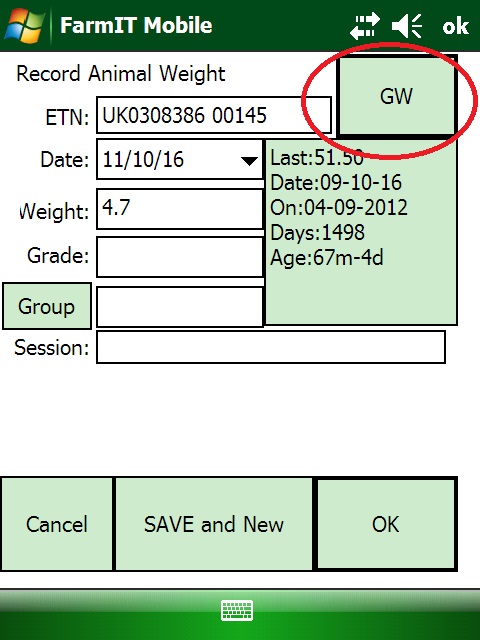
FarmIT Mobile - Individual Weight
The individual weight option allows you to manually record weights for animals, finding the animals by EID or manually.
The GW (get weight) button gets the current weight from the scales or you just
type in the weight.
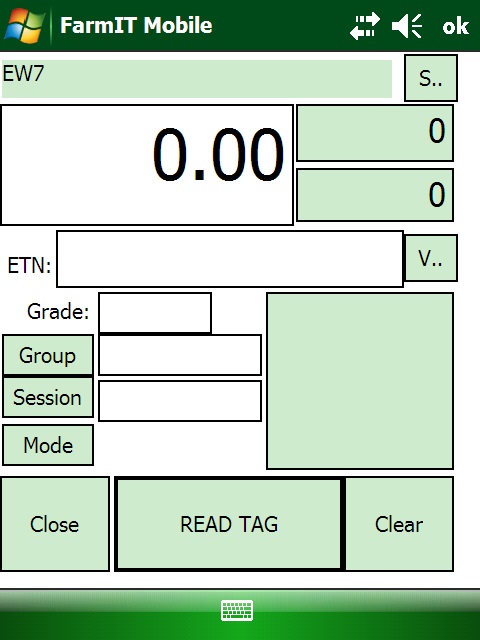
FarmIT Mobile - Weigh Scales
The weigh scales screen is used as an extension to the scales. It allows you to
read the EID of the animal and it automatically brings in the weight from the
scales. The weight is automatically saved. You may also use 'Modes' for grading
/ BCS and grouping. The connection to the scales is opened automatically and the
weight updated. When using an EW7 the weight only updates as the weight goes
stable.
What are Modes
The mode option allows you to collect other data associated with the weight, for example the BCS (Body Condition Score) or Group
What is a Session?
The session option lets you enter a name I.E 'Tupping 2016'. It also lets you
review statistics for the session, number of animals weighed, min, max weight
etc.
A Quick Note ON Scales
There are only a few manufacturers producing weighing equipment specifically for weighing live animals. Weighing live animals differs from the norma in that these scales provide an averaged weight based on time. This is to overcome the fact that the animal is normally
alive and moving. Such scales are not normally subject to certification and
therefore not approved for 'TRADE' use. I.E the weight is considered approximate
and not accurate. Tru-Test scales are clearly labelled as such. If you were
selling butchered meat for example you would have to have your scales regularly
inspected and certified to cover trading standards legislation. Tru-Test Scales
with MP600 loadbars are accurate to 0.5 Kg. The accuracy being dependant on the
loadcells in the bars and the calibrated resolution. This level of accuracy is
fine for live animal weights and of course has mimimal effect on a 576 Kg Steer.
Note on Animal Live Weights
Given we have just said that the scales are not accurate why bother at all? Well the first and major issue to understand is that we only need to be accurate to 1 kilo for most cattle and sheep applications. If we exclude lamb birth weights the weight of the animal will vary considerable. For example a 26 Kg Lamb can have between 0 and 4 Kg of gut fill. So what ever the scales actually say the animals weight is only approximate and if we were to weigh the animal again say 4 hours later it is very likely we would get a different result.
Scientific trials for example weigh the animal 3 times in 24 hours and then take
an average result. This is of course not very practical on farm.
OK so how do we know its growing. Well Daily Live Weight Gain (DLWG), or the gain
between two weighing session divided by the number of days gives us a growth
rate. Again due to gut fill doing this under 14 days can give erroneous results
however over this period errors due to gut fill have less effect and we can use
the DLWG figure as a measure of performance with confidence.
So WHAT is good!
DLWG will vary and most animals slow down as they grow, so what would we expect from lambs. Well many factors effect this including, breed,
feed, field and farming method etc, but lets just put some figures into perspective
Growth rates in commercial lambs up to 12 Months of age
500 Grams
For most animals this is exceptional. 500 grams will make him 45Kg in 90 days, so pretty good and at the top end of commercial performance
300 Grams
This is a good average performance and well achievable with healthy well feed animals. 300 grams will make him 45Kg in 150 days.
Most of our commercial customers would acheive this with minimal effort on 90% of
there lambs
150 Grams
This is poor and could indicate a lack of feed, nutrition or mineral, worm problem or ill health. 150 grams will make him 45Kg in 300 days. So very slow and probably uneconomical.
10% of lambs will probably fall into this catagory due to poor mothers, poor
genetics or bad luck,
Less than 100 Grams
This animal is serverely challenged and probably ill! 100 grams it takes him 450 days to get to 45 Kg. You will probably give up on him before that!
However growth rates vary!
Most lambs start quite well and up until about 6 weeks depend on mothers milk to
achieve that growth. It does also seem true that lambs that fail to do well
during this period continue to struggle. It is for this reason that we would
encourage you to weigh early and adopt a 6 - 8 week target weight. Although this
may seem early to start worrying about the weight once you do it you will
understand our reasoning. It is also a good time to check on the number of lambs
that have survived!
Past 8 weeks lambs will slow but should not grind to a halt!, Basically 200 grams
should raise concerns, less than that indicates a real problem and you should
check worms etc. any dramatic drop in DLWG should be investigated.